
Index:
Iran courts continued oppression of the Bahai’s
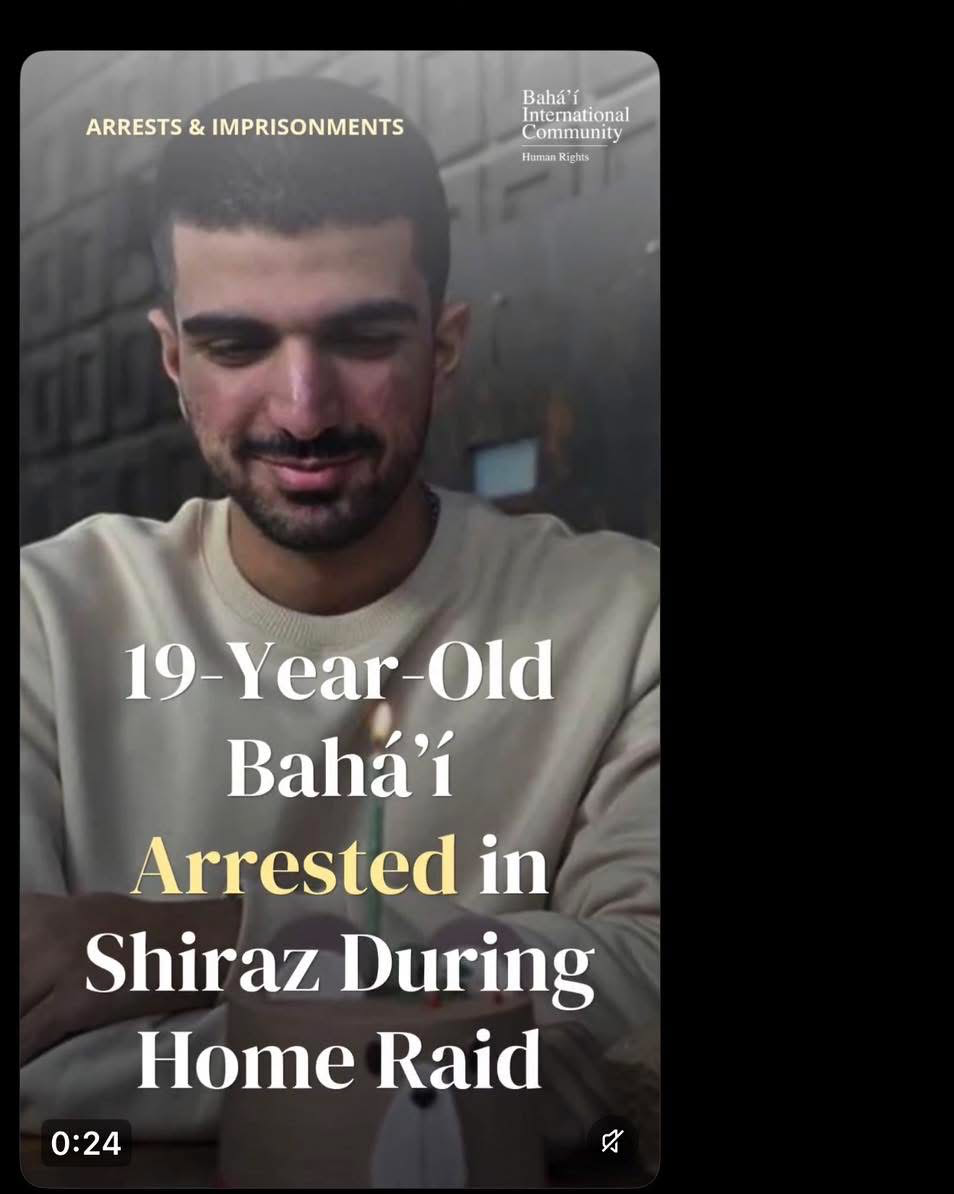
Please pray for 19-Year-Old Bahá’í Arrested in Shiraz During Home Raid
On the evening of 7 April 2026 Iranian intelligence agents arrested a 19-year-old Bahá’í, Mr. Angha Siavashi, during a raid on his family’s home in Shiraz.
The arrest took place without a judicial warrant.
The agents conducted a comprehensive search of the residence, confiscating personal belongings including photo albums, books, religious items, gold, and electronic devices such as computers, laptops, modems, and mobile phones.
Security personnel also searched visitors who were present at the home, seizing their phones and jewellery.
The reasons for Mr. Siavashi’s arrest and any formal charges have not been disclosed. He is the son of Mrs.
Parisa Rouhizadegan who has previously faced convictions linked to her Baha’i beliefs.
Link to Baha’i International Community Human Rights article on X:
https://x.com/bahaibic_rights/status/2044406388772741419?s=46
Continuation of Mock Executions Against Baha’is; Global Baha’i Community Raises Concern Over Borna Naimi’s Fate
HRANA – Borna Naimi, a Baha’i citizen residing in Kerman, remains in a state of uncertainty after 39 days in detention and is still being held in solitary confinement in Kerman Prison.
In a statement, the global Baha’i community expressed concern over his situation, announcing that he has been subjected to mock executions twice in order to extract forced confessions. Previously, the organization had also reported mock execution practices against Peyvand Naimi, another detained Baha’i citizen in the same case. The statement notes that the treatment of these two young Baha’is has heightened concerns over the intensification of persecution against Baha’is in Iran.
The global Baha’i community, expressing concern over Borna Naimi’s fate, stated in a declaration, shared with HRANA, that: he has “endured at least two mock executions, electric shocks causing severe burns to his feet, and other forms of torture, since his arrest in Kerman on 1 March.”
The statement emphasizes that following Peyvand Naimi, Borna Naimi is the second Baha’i detainee in Kerman to be subjected to mock execution, “raising concerns regarding the intensification of the persecution against the Baha’is in Iran, the country’s largest non-Muslim religious minority.”
According to the statement, this is the second case involving detained Baha’i citizens in Kerman accused of involvement in the killing of Basij agents during the protests of January 7, 2026. However, “Borna’s torture was so extensive that he was forced to sign a false confession in which he implicated himself and his cousin, Peyvand Naimi, in killing Basij guards during 8 January protests. No evidence exists for this charge, and neither Borna nor Peyvand could have committed these crimes, as they occurred after Peyvand had been detained and while Borna was surrounded by family at home. The text of his forced confession had been prepared beforehand and handed to him to read. No trial has been held for either prisoner.”
The statement continues: “During the first days of detention, Borna was repeatedly beaten, receiving multiple blows to his sides, ribs, beneath the chest, and his back. He was transferred several times to places near his residence, where he was pressured with threats concerning his wife and young daughter, including threats that his child would be sent to a state orphanage if he did not cooperate. ”
In this context, a representative of the global Baha’i community at the United Nations in Geneva stated: “During the initial days of detention, Borna was held in a special section of the prison known as the ‘death suite,’ where prisoners sentenced to execution are kept 48 hours before their sentence is carried out. Reports indicate that during this period, he was held in a small solitary cell of approximately two by two meters and was unable to distinguish day from night.”
Simin Fahandej added: “During his first days in prison, Borna was held in a special section of the prison called the “suite”—the “the death suite”—in which death row prisoners are held 48 hours before execution. Reports indicate that, during this time, he was held under solitary confinement in a small room about two-by-two metres in size, in such a way that he could not distinguish between night and day.”
She further stated: “The treatment of Borna and Peyvand is a stark indication of the Islamic Republic’s relentless efforts to fabricate accusations against the Baha’is and falsely present them as responsible for crimes they did not commit. It raises grave concerns about the plans and intentions of the Iranian government for the Baha’is in Iran, who have, time and again, been scapegoated at moments of national crisis as a means of deflecting attention from its own deepening repression. Such actions not only endanger innocent lives but further entrench a pattern of systematic persecution that seeks to isolate, dehumanize, and ultimately silence an entire minority community.”
Previously, HRANA had reported on the use of mock execution and abuse against Peyvand Naimi in an effort to extract forced confessions.
Borna Naimi, a 29-year-old Baha’i citizen, father of a three-year-old child and resident of Kerman, was arrested on March 1, 2026, by security forces.
Over the past decade, the Baha’i community in Iran has faced more security and judicial pressure than any other religious minority. A review of HRA’s annual reports shows that in the past year, an average of 62.41% of reports concerning religious minorities involved violations of the rights of Baha’is.
Rats, cold, filth, and no proper shower—yet hope survives.
A Window into the Prisons of Iran: A Writing by Raha Sabet, a Bahá’í Prisoner
This writing, filled with hope and a vision of reconstruction of society, is penned by Raha Sabet, a Bahá’í prisoner who spent 3 years and 4 months of her 4-year sentence in solitary confinement under exhausting conditions. Her “crime” was the betterment of her homeland and love for her fellow citizens. Her spirit, full of joy and strength, is an inspiration to us on this side of the bars.
“Adelabad is one of the well-known and old prisons of Shiraz. For as long as I can remember—since about the age of ten—for a period of two years, once a week we would go with our family to visit my grandfather (Ahmad Ali Sabet), my uncle (Parviz Gohar-riz), and my cousin (Akhtar Sabet) in Adelabad Prison.
What has remained vividly in my memory from that time—about 27 years ago—are the high walls, the visitation halls and booths, the innocent and spiritual faces of the Bahá’í prisoners, and the eagerness and longing of the families. (As you know, in the early years of the Iranian Revolution in 1979, Bahá’ís were arrested for membership in and activity within the Bahá’í community; in the Islamic Revolutionary Courts some were sentenced to imprisonment and some to execution. My cousin, Akhtar Sabet was one of those ten young women who were executed in Shiraz on June 18, 1983.)
My mental image of Adelabad Prison consisted of these scenes—and of course the days filled with anxiety and distress for families when they received news of the execution of their loved ones. Time and again I had heard from the families of Bahá’í martyrs and prisoners about those days, and read their accounts; with all my being I learned from their honor, dignity, courage, and the steadfastness of their families, and I was grateful to God for having such illustrious forebears.
Yet it was far from my imagination that I myself would one day find myself in the environment of Adelabad Prison—especially since I had already spent three years and four months of my sentence in solitary confinement in a detention center of the Revolutionary Guards’ intelligence.
But February 13, 2011, will remain a memorable day for me, for on that day I was transferred to Adelabad Prison to continue my sentence. Although I cannot deny that entering that place and witnessing the condition of the prisoners and the environment of the prison was shocking, now that a few days have passed, I feel that one can adapt to these new conditions.
What I intend to write in this letter is to describe, as a Bahá’í prisoner who has been released for two days from a public prison on leave, the conditions and environment of that place, so that respected readers may better and more deeply understand the situation of prisoners and public prisons in Iran. Perhaps this awareness will help all of us to fulfill our duty and responsibility to strive for the improvement of conditions and the freedom of all prisoners—Bahá’í and non-Bahá’í alike.
The prison in which I and ten other women are held is known in the terminology of Iranian prisons as an “open prison.” An open prison means that inmates, upon providing property bail (approximately 50 to even 100 million tomans), may spend several nights a week—usually two or three—at home, and during the day work in prison workshops or within the prison environment (tasks such as cleaning, carpentry, construction, sewing, carpet weaving, and so on).
According to the prisoners themselves, under these conditions they must pay approximately 200,000 tomans per month to the prison, half of which is later returned to them. Considering that this amount is generally paid from their prison wages, one can understand how much hardship they face. The purpose of such arrangements is to allow prisoners to be present with their families and children while also serving their sentences. (It should be noted that this arrangement is granted only after a certain portion of a sentence has been served and under specific conditions.)
But the reality: The approximately ten women imprisoned alongside me are mostly serving life sentences, and only after many years have they been able to enter this “open prison” system. Their crime has been selling narcotics. Most have separated from their husbands—who were themselves addicts or drug dealers—and they are now the heads of their households. Their ages range from 25 to 60.
Their children, who are minors or adolescents, had previously been under the care of welfare institutions or relatives while their mothers were in closed prison. Anyone who listens carefully to their stories cannot in fairness consider them solely at fault. If they had had access to a relatively healthy social environment, proper education, financial and job security, and even a small measure of emotional support from family and society, they might never have committed these crimes nor spent the best years—or even all—of their lives in such a place.
A brief look at their condition reveals that the harshness of personal and social circumstances has forced these prisoners to sacrifice many of their human virtues in order to survive, care for their children, and earn a livelihood. One can truly understand how difficult it is to preserve spiritual qualities and human dignity under such conditions. Certainly, no one can judge them without having experienced their circumstances—circumstances in which they are rejected not only by their families but also treated poorly by society and its authorities.
Imagine that the space in which these prisoners live is an old kitchen, only one-third of which is usable, while the rest is occupied by broken knitting machines intended for prisoner employment. Part of the ceiling is partially open for ventilation, but in the cold winter air, freezing wind enters, and during rain the entire floor becomes flooded, requiring constant sweeping to keep the sleeping area dry.
The floor is tiled, partly covered by a small carpet. There are a limited number of blankets—although each prisoner is supposed to have three, most have only one or two—making the cold even more difficult. The walls are also tiled, adding to the chill. There is a toilet inside the room without ventilation, and insufficient water for cleaning. There is no shower; prisoners use a hose connected to a sink while others sit nearby. Water from washing and bathing flows across the floor and must be swept away.
Hygiene conditions are deeply concerning. There is no sunlight, no outdoor time, and no proper ventilation, leading to dampness and polluted air that threatens health. Prisoners recount that in previous years, when the cell functioned as a closed prison, they lived under these conditions for four years, even dealing with rats entering the space.
They worked at carpet looms for long hours, receiving minimal wages, which they used for basic necessities or sent to their children.
Food is often insufficient, and lack of access to proper nutrition leads to further hardship and behavioral strain. There are no meaningful activities—no television, radio, or reading materials. Recently, some prisoners were punished for possessing cigarettes or drugs, and all were penalized collectively. Those suffering withdrawal were denied medical care.
In these conditions, suffering intensifies—not only physically but emotionally. The lack of humane treatment leads to conflict, neglect, and despair among prisoners. It becomes clear that imprisonment results not in rehabilitation but in deep psychological and moral harm.
Apart from the steadfastness of Bahá’í prisoners—who, through their faith, bring patience and compassion—it is evident that action must be taken to improve the condition of all prisoners. This may be an opportunity for society to serve through consultation and engagement with authorities and institutions.
These conditions are not limited to Adelabad but exist across prisons in Iran.
I would also like to remember Bahá’í prisoners in other cities, as well as non-Bahá’í thinkers, writers, and citizens imprisoned for their beliefs. None deserve such conditions.
Though prayer is always the greatest comfort and means of resolution, prayer alone without action cannot bring about divine confirmation. Opportunities for service are among the greatest blessings granted to us—let us transform them into spiritual growth for ourselves and society.
With devotion,
Raha Sabet
February 17, 2011
(Human assisted AI translation from original Persian)
Persian translation
Latest incidents expose Iranian authorities torturing a Baha’i prisoner to manufacture evidence against another—as concerns grow that the Islamic Republic is cracking down further on Iranian Baha’is

GENEVA—8 April 2026—
Borna Naimi, a 29-year-old Baha’i in Iran, and father of a three-year-old, has endured at least two mock executions, electric shocks causing severe burns to his feet, and other forms of torture, since his arrest in Kerman on 1 March.
His treatment, and that of another young Baha’i who faced similar treatment, are raising concerns regarding the intensification of the persecution against the Baha’is in Iran, the country’s largest non-Muslim religious minority.
During the first days of detention, Borna was repeatedly beaten, receiving multiple blows to his sides, ribs, beneath the chest, and his back. He was transferred several times to places near his residence, where he was pressured with threats concerning his wife and young daughter, including threats that his child would be sent to a state orphanage if he did not cooperate.
Borna’s torture was so extensive that he was forced to sign a false confession in which he implicated himself and his cousin, Peyvand Naimi, in killing Basij guards during 8 January protests. No evidence exists for this charge, and neither Borna nor Peyvand could have committed these crimes, as they occurred after Peyvand had been detained and while Borna was surrounded by family at home. The text of his forced confession had been prepared beforehand and handed to him to read. No trial has been held for either prisoner.
Borna and his young daughter have a close relationship. The brutal psychological pressures surrounding his child have been intended to break Borna mentally to force him to confess to crimes he did not commit. The situation has caused great distress in his daughter—who thinks her father has abandoned her. Borna is known among other prison inmates as the prisoner who keeps the drawings and clothing of his daughter on the wall near him.
“It is impossible to not feel immense heart ache for the plight of this family, who have suffered such cruelty solely for their faith,” said Simin Fahandej, the Baha’i International Community’s Representative to the United Nations in Geneva. “History will remember not only the merciless crimes of the Islamic Republic of Iran, but also the courage and bravery of youth who, relying only on their inner convictions and beliefs, have stood firm in their beliefs in the face of a government that has stopped at nothing in its attempt to crush them.”
During his first days in prison, Borna was held in a special section of the prison called the “suite”—the “the death suite”—in which death row prisoners are held 48 hours before execution. Reports indicate that, during this time, he was held under solitary confinement in a small room about two-by-two metres in size, in such a way that he could not distinguish between night and day.
Borna was also extensively tortured further, including the use of electric shocks so extensively that it caused burns to his legs.
Borna’s mock executions follow the same treatment against Peyvand as reported on 24 March by the Baha’i International Community.
The cases raise serious concerns over the escalating persecution and violence facing Iran’s Baha’is as the Iranian government attempts to frame them for Iran’s crisis situation. Alarm over rising persecution comes as the authorities are attempting to scapegoat the Baha’is for the January 2026 protests and the current conflict.
“The treatment of Borna and Peyvand is a stark indication of the Islamic Republic’s relentless efforts to fabricate accusations against the Baha’is and falsely present them as responsible for crimes they did not commit,” said Ms. Fahandej.
“It raises grave concerns about the plans and intentions of the Iranian government for the Baha’is in Iran, who have, time and again, been scapegoated at moments of national crisis as a means of deflecting attention from its own deepening repression. Such actions not only endanger innocent lives but further entrench a pattern of systematic persecution that seeks to isolate, dehumanize, and ultimately silence an entire minority community.”
Background
For more information, please contact

March 24, 2026

Based on information received by HRANA, Shayan Abadi, 31 years old, was arrested on Monday, March 23, 2026 by agents of the Ministry of Intelligence in Kerman. As of the time of this report, no information is available regarding his place of detention or the charges against him.
Over the past decade, the Baha’i community in Iran has faced more security and judicial pressure than any other religious minority. A review of HRA’s annual reports indicates that over the past year, on average, 62.41% of reports concerning religious minorities were related to violations of the rights of Baha’i citizens
30 March 2026 15:23
Hengaw – Saturday, March 30, 2026
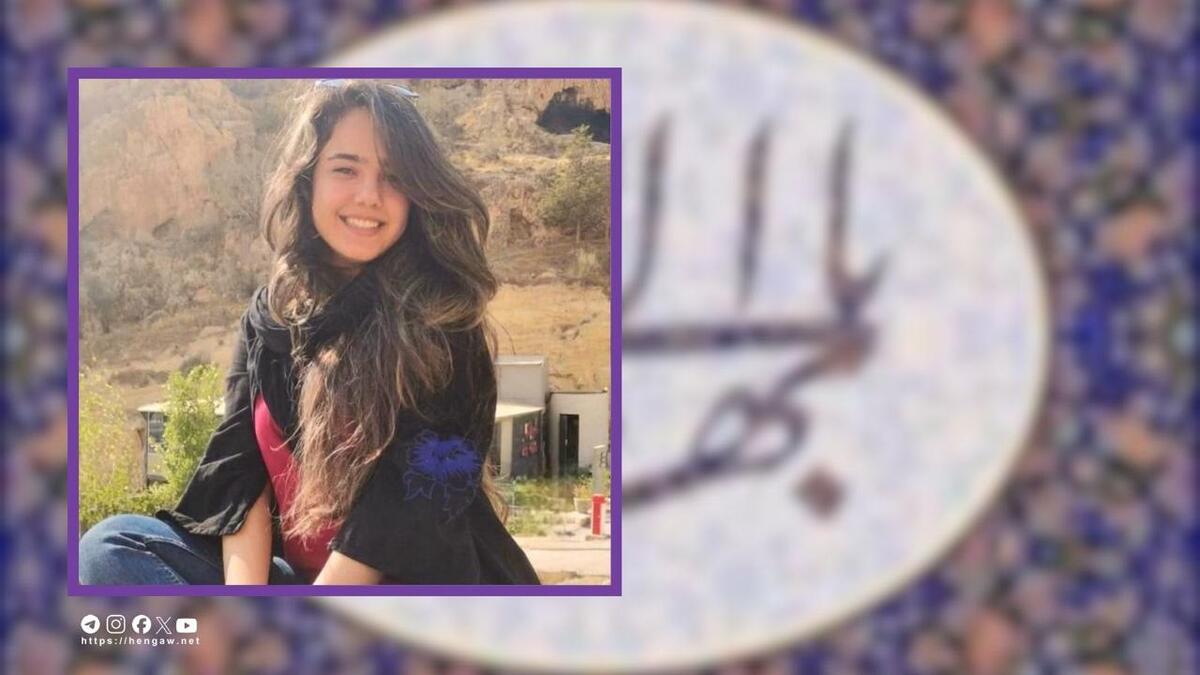
Mahsa Sotoudeh, a 25-year-old Baha’i resident of Shiraz, was arrested by Iranian government forces and taken to an undisclosed location. She is the third Baha’i adherent to be detained in the city in recent days.
According to information received by the Hengaw Organization for Human Rights, intelligence forces of the Islamic Revolutionary Guard Corps (IRGC) raided Sotoudeh’s home in Shiraz and arrested her at around 6:00 p.m. on Sunday, March 29, 2026.
Informed sources told Hengaw that agents conducted a thorough search of the house, confiscated electronic devices belonging to all family members, and then transferred her to an undisclosed location.
Sotoudeh is a close relative of Pezhman Zarei, another Baha’i adherent who was arrested in Shiraz in mid-March 2026 and, nearly a month later, remains in an uncertain situation at an undisclosed location.
No precise information is available regarding the reasons for her arrest, the charges against her, or her place of detention. Ongoing efforts by her family to obtain information about her fate have so far been unsuccessful.
Updated / Wednesday, 25 Mar 2026 18:44

Ailbhe ConneelyBy Ailbhe Conneely
Social Affairs & Religion Correspondent
A member of the Bahá’í community in Ireland has expressed concern over what she has described as torture, interrogation and mock executions that her cousin is enduring in Iran.
Sama Sabet, who lives in Dublin, has called for the support of the international community, following the arrest of her cousin Peyvand Naimi on 8 January.
The 28-year-old was arrested during the Iranian government’s response to protests at the time and was taken to an Islamic Revolutionary Guards Corps (IRGC) detention centre on what his relatives have described as “false charges”.
They say he is being persecuted for being a member of the Bahá’í faith.
The United Nations and international rights groups have documented the persecution of Bahá’ís in Iran for many years; including denial of civil rights, imprisonment, torture and destruction of property.
According to Ms Sabet, following weeks of torture, on 1 February, Mr Naimi was forced to confess on state television to “a number of baseless charges.”
At the end of February, he was accused of being involved in the deaths of three Basij security agents during the January protests, despite Mr Naimi being in detention at the time of the alleged attack.
He was also accused of celebrating the death of Iran’s former supreme leader, Ali Khamenei on 28 February – an event Ms Sabet has said her cousin had no knowledge of because he had no access to communications as a prisoner.
In a statement, the Bahá’í International Community has said that Mr Naimi is “in serious danger after enduring two show executions and prolonged torture and interrogations”.
The UN’s Bahá’í International Community Representative Simin Fahandej has backed the family.
She said the Islamic Republic did not have “a single shred of evidence” for the accusations.
“If it did, it would not have to resort to torture to extract a false confession. There is only one reason for this cruel treatment, and it is that Peyvand is a Bahá’í.
“It is the same reason Iran’s government has persecuted and discriminated against an entire innocent community for almost five decades,” she said.
She called for the international community to act fast and insist Iran “stop its senseless targeting of Bahá’ís”.
Ireland has consistently condemned the persecution of Bahá’ís in Iran.
A year ago, at the 58th Session of the UN Human Rights Council, Ireland’s Permanent Representative to the United Nations Noel White condemned the “continued discrimination and oppression of minority groups in Iran”.
He said members of the Bahá’í faith in particular faced limits in realising the right to education and accessing legal representation. Mr White also expressed Ireland’s increasing concern over the detention and oppression of Bahá’í women.
According to Ms Sabet, Mr Naimi has faced constant and severe torture, interrogation, and denial of food and water during his imprisonment.
She said that her cousin was “completely innocent of all charges” and that there was no evidence to support any of the claims and that he should be released immediately.
There are around 500 members of the Bahá’í faith living in Ireland.

This photo was taken by a young woman Baha’i in Shiraz. This was taken before the war but now I post it in hope of peace for The world and Iran in particular.
this site is an individual effort copyright by Sam Murray. Contact: Sam.murray@ymail.com